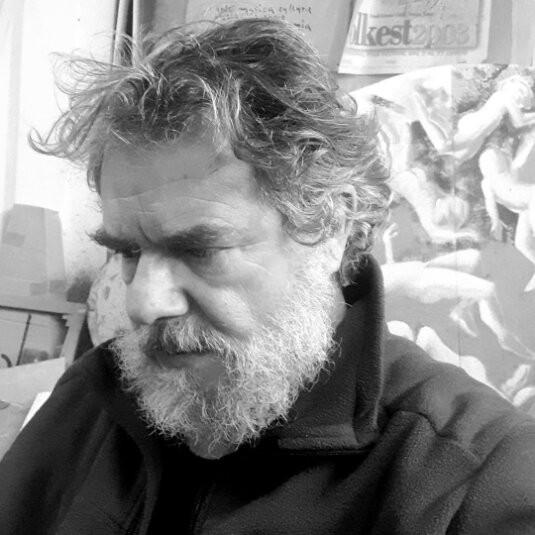
Stefano Jus
He was born in Pordenone in 1963.
He received artistic training under the guidance of his father, Duilio.
From 1984 to 1993, he worked at a design studio in Pordenone, collaborating with various professionals.
During this period, he created large-format murals in the Pordenone area and stained glass windows for several churches in Veneto and Friuli.
Since 1985, his paintings have been displayed in solo and group exhibitions organised in Italy and abroad.
In 1995, he founded GIOCOFORMA, a workshop for producing toys and furnishing accessories.
In 1999, he was invited to participate in the international competition for EXPO 2000 in Dessau.
Since 2000, he has exhibited large-format wooden sculptures in various municipalities in the Pordenone area and contributed paintings, sculptures and mosaics to several public spaces in the region.
Through the Scuola Mosaicisti del Friuli, he has completed several mosaic projects in Europe.
His most notable awards include first prize at the Padua Biennial in 1986, the TOP TEN Promosedia Udine award in 1995, first prize at the Singapore International Fair in 1997, the CATAS award in 1998, second prize at EXPO 2000 Bauhaus Dessau in 1999 and the International Mosaic Trend Award for a triptych for the Church of S. Lorenzo in 2012.
He has recently produced several artists' books on: San Vito, Gherardo Freschi, Harry Bertoia and 'Il Pordenone'.
In 2016, he designed and built a wooden church on the Adriatic coast in Eraclea.
In 2020, he created a monument to celebrate work in the Ponterosso industrial area of San Vito.
His most recent solo exhibition took place in Venice in 2022 at Palazzo Contarini Scala del Bovolo.
He will be present at the Triveneta Biennale in Pergine, Moriago and Zoppola in 2024, as well as at the Preludio exhibition at the Diocesan Museum and Tiepolo Galleries in Udine.
He currently teaches drawing and colour at the Scuola Mosaicisti del Friuli, where he is also the educational coordinator and collaborates on theatrical events and design-related projects.
Critical text by Enrico Lucchese
Words carry weight, even when they are floating in water. The premise of the exhibition at Palazzo Altan-Rota is based on the masterpiece created by Stefano Jus four years ago at the 'Ponte Rosso' business centre, which is part of the Local Economic Development Consortium of the San Vito al Tagliamento industrial area. There, a square slab of reinforced concrete floats as light as a leaf, bearing the opening words of our Constitution. The letters are embossed or engraved to demonstrate that even a message of such importance to true freedom can be incomplete and perhaps even imperfect, based not on easy certainties to be accepted without question, but on the daily courage of each one of us.
Today, the words 'Italy is a democratic republic founded on work' appear once again in works exhibited in the first room of Jus's solo exhibition in the Friulian municipality. They stand out on a large sculptural table with human figures above and fish below, both the same size as the letters. The figures appear to be dancing in an airy element, while the fish appear to be dancing in a liquid one. There is also a series of engravings with inscriptions printed in reverse, as well as graphic interventions by the artist. The characters are slender and depict fish, birds and plants. These light, monochrome and watercolour presences live at the bottom of the 'Ponte Rosso' basin and look towards us (hence the inverted epigraph!), questioning whether the fundamental principle of the 1947 Constitution has been implemented. Other minute anthropomorphic beings appear in the works on display in the second room, but there are no inscriptions or signs to guide us. These are the 'Tiratori di mat', tireless ants who are one with their humble work under streaked skies. They are as strong as the raw canvas that emerges from the colours spread out in energetic lines.
This energy is particularly evident in the Discs, an archaic form that Jus is working on. It moves from a circle filled with primitive dancers to broken millstones over which stratiform clouds linger. The figures are precipitated in the lower register and are destined to become hieroglyphs, or perhaps the symbols engraved on the Cretan Disc of Phaistos — an enigma of the Minoan language. Once again, the word is unintelligible to us (our ears are sometimes accustomed to empty speeches or oaths), as is the dynamic eternity of the circle, which is evident even in the exhibition itinerary. It resumes the steps towards the first section of the exhibition, where, alongside the sequence of reflections on the theme of monuments to work in industrial areas, there are preparatory studies for the mosaic design of the 'Ponte Rosso' logo: a shell inhabited by the essences planted in the green areas of the Consortium. Today, more than ever, the garden is a language to be read, listened to, and passed on; it is part of the whole — the syntax of a universal language constituted and regulated by graphia (a Greek word meaning both writing and drawing).
In this exhibition, Jus displays two of his books in which letters and images are integrated. The comma that was placed by the Constituent Assembly between the words 'democratic' and 'founded' in our first article has been removed. This article establishes that work is not merely an economic relationship, but that it has a particular social value. It is a right and a duty to 'carry out, according to one's abilities and choice, an activity or function that contributes to the material or spiritual progress of society' (Art. 4). The omitted punctuation mark imbues the uninterrupted sequence of words with symbolic power, creating a visually cacophonous yet solemn effect. However, it was drowned out by the noise of the Brandizzo train brakes on the night of 30 August last year, the collapse of the beam at the Esselunga construction site in Florence on 16 February 2024, and the explosion under Lake Suviana a few weeks ago. Too often dismissed as a charade, this seemingly simple phrase, governed by the first verb used by humans, must form the basis of civilisation: civilisation.
Critical text by Massimiliano Pavon
In his designs, paintings and artistic installations, Stefano Jus seems to favour the 'surface' over the 'tubular form', perhaps due to his creative experiences in the woodworking sector in his youth, particularly with wooden panels. But it is also the surfaces of stone, brick and concrete walls; the walls of houses in the Veneto-Friuli countryside; the horizontality of floors and attics that delineate spaces where human life takes place; and the material extensions that can be interpreted in various ways through his different techniques.
The surface is where weaves, warps, textures, and chromatic and material irregularities, which condense and stratify lived experience, are concentrated. They act as a screen onto which imperfections, tracing the path of existence, are projected: from the depths of bitumen to the peaks of luminous vibrations and the most intense, chalky whites, burnt by sunlight.
Furthermore, rural expanses measured by the perspective lines of crops and shading in shades of green and earthy tones from ploughing and water, as well as skies and clouds, are also not exempt from this areal consistency: a succession and overlapping of superficial, connective 'fabrics' rather than focal points and fixities that resist the gaze by taking root in depth.
Therefore, in Stefano Jus's work, the inevitable inertia of the masses is not so much attenuated or contradicted by 'pictorial' and luminous dematerialisation, but rather by the 'wind' of an ancestral energy that always emanates from the earth. This energy encompasses and metabolises the masses in an unceasing, magmatic, metamorphic process that nevertheless maintains a physical verifiability — an almost analogical reference — to the everyday reality of winds sweeping across plains, descending from mountains to sea; the cyclical dances of sun and moon; and the incessant struggle between darkness and light.