Design reflections preceding the ARTCIRCE project.
Pebbles Have Long and Intense Lives.
No one remembers their distant origins — born under the sway of primordial forces that lifted ancient sea sediments toward the sky.
Then came the timeless slumber, in the silent, dark belly of the mountain.
Outside, a living world unfolded: water and ice, heat and frost ceaselessly sculpted slopes and hollows.
Until, drop by drop, ray by ray, that outer world reached inward — releasing each pebble to the adventurous rush of streams: first steep and exuberant, then level and serene, branching endlessly toward the distant sea.
Above them stretched the blue of the sky, the darkness of night, the ever-shifting forms of clouds, the unpredictable play of light.
Their textures and colours bear witness to this immense journey — a genetic imprint of unrepeatable uniqueness.
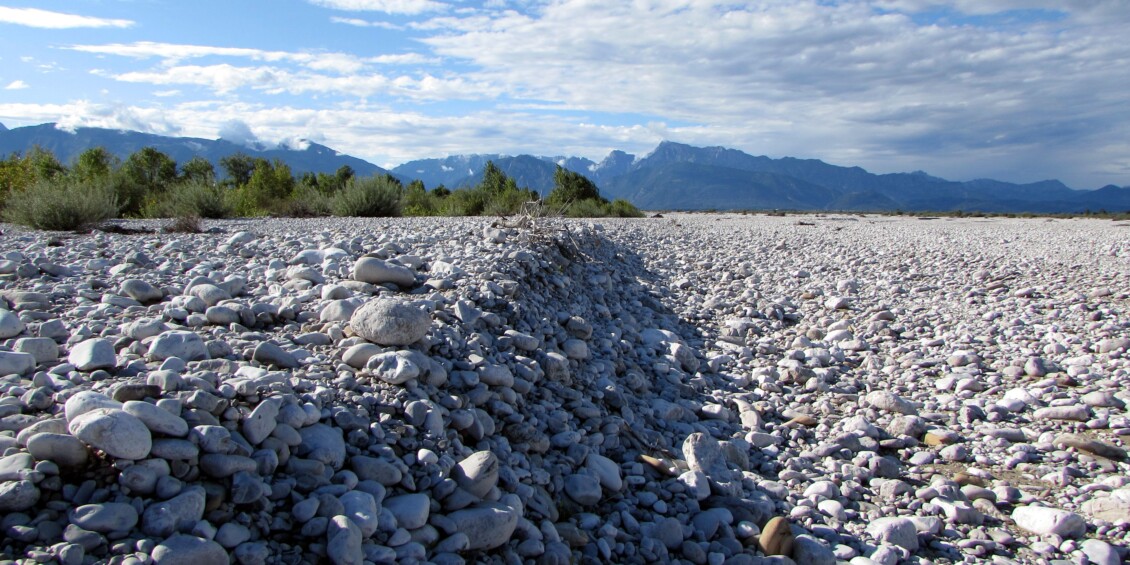
The Magredi are a region of the western Friulian plain in north-eastern Italy, fanning out from the foothill towns of Maniago and Montereale Valcellina toward Cordenons and Pordenone. The area is defined by the gravelly deposits of the Cellina and Meduna streams.
The word Magredo comes from the local Friulian expression terra magra — “poor land,” dry and low in water — a paradox, since Friuli-Venezia Giulia is one of Italy’s rainiest regions.
This landscape is, in fact, composed of stones deposited by streams at the end of the last glaciation. As the mountain torrents reached the plains, their flow slowed, allowing them to meander and to deposit the heavier, coarser materials.
Over millennia, the movement of water carried away the smaller fragments, gradually transforming the larger stone blocks into smooth, rounded pebbles.
At the mouth of the valley, where the Cellina and Meduna enter the plain, the waters sink beneath the gravelly deposits and flow underground, creating an arid landscape with no visible rivers — the distinctive face of the Magredi.
In summer, these dry meadows appear barren and waterless, recalling the continental steppes of Eastern Europe or even desert lands.
Further south, water resurfaces along the so-called linea delle risorgive (“line of resurgence”), where clay and sand dominate the soil.
Beyond the stony terrain, vegetation gradually takes hold, spreading until it forms a continuous mantle of permanent grassland.
Sheltered by the mountains from northern winds, and warmed by the stones that accentuate the contrast between day and night, the Magredi form a unique microcosm — a meeting of austerity and vitality.
They have recently been recognised by the European Union as a “Site of Community Importance.”