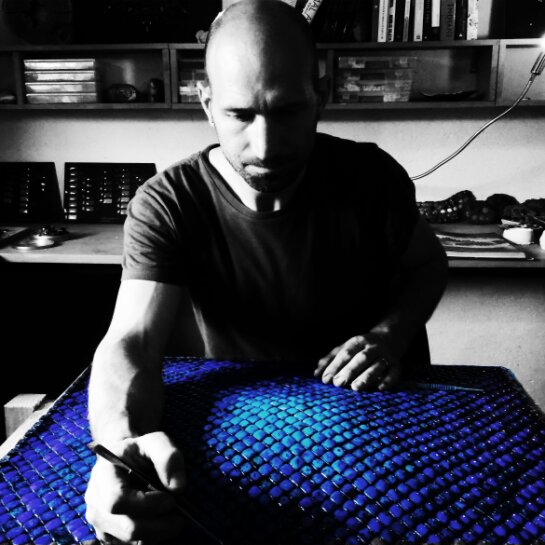
Luca Nardini (1982, Italy)
From an early age, I have been fascinated by the incredible natural world and its infinite variations and colour combinations. Nature was my first great inspiration: a silent teacher, ever-present for those who choose to stop, observe, and listen to themselves in silence.
My second source of inspiration is human history. I search the past of ancient civilisations for lost and hidden elements, rediscovering powerful, ancient symbols and geometries that are still present today and are linked to the most ancient mysteries of man's origin and his connection with his gods.
I began my formal artistic training in 2005, obtaining my diploma from the Scuola Mosaicisti del Friuli in Spilimbergo. I specialised in a further fourth year of training in 2006.
Over the next few years, I experimented independently with various materials, such as wood, metals and ceramics, and presented a number of my diverse works in solo and group exhibitions in Italy and France. I lived in France from 2008 to 2010 and received various personal rewards, while engaging with other artistic communities.
Subsequently, I consolidated my training through a period of several years working in the restoration workshop of St Mark's Basilica in Venice under the supervision of the Procuratoria from 2010 to 2017. This experience allowed me to deepen my knowledge of restoration techniques and has led me to my current position. Since 2022, I have taught the advanced course and Byzantine and contemporary mosaics in the second year at the Scuola Mosaicisti del Friuli, passing on to my students a passion for art above all else.
My research into this subject began over 20 years ago in my workshop, where I conducted self-directed experiments with glass pastes and enamels — materials traditionally used in mosaic techniques — to see what I could achieve.
I was immediately fascinated by the results, which remain at the core of all my personal work to this day.
Currently, as I undergo a phase of inner transformation and personal growth, I am completely renewing this research and its results, meaning none of my previous work belongs to this new personal chapter of expression.
The technique
This new technique involves fusing a single tile – a common, neutral mosaic element – onto a ceramic base at a high temperature.
This marks the beginning of the transformation: the piece of enamel changes shape, loses its identity, and undergoes a complete alteration of its essence. However, it regains its identity in the final phase and subsequent firings. The colour variations continue and become further enriched according to specific criteria and a variety of personal techniques.
Through variations in the material's chemical and physical state, element combinations and deliberate and random alterations resulting from years of experimentation, a new colour is created. This is not a sterile, impersonal colour, but a subjective, exclusive colour that can be saturated, diluted, compact, fragmented, transparent, full, opaque or iridescent.
Furthermore, the opportunities offered by ceramics allow for variations in the shape and size of the pieces, exponentially increasing the infinite number of colour combinations that can be created.
The resulting piece becomes a unique and precious element with the characteristics of a gem or jewel. When combined with other pieces, whether identical or different, it forms an image and acquires an identity, evoking a story with unique and unrepeatable combinations.
The final characteristic is the use of gold. From a chromatic point of view, it reflects light; from a prestige point of view, it adds value; and from a more subtle point of view, it gives the works a spiritual, regal character, leading the observer towards the divine.
The meaning of research.
Working with materials is an expression of research and an internal process that operates on several levels.
The mosaic technique, by its very nature, prompts reflection on the fragmentation of the image and, consequently, of human identity. In contrast, the fusion technique provides an additional process of introspective analysis that is more ancestral and profound. This process is linked to the material and aims to reimagine the fundamentals of existence and creation. Using clay and then applying high temperatures creates a fascinating, almost magical act of transformation, enabling us to shape a new reality or bring an ancient identity back to light.
The ultimate meaning of this experimentation is therefore to awaken personal and, more generally, human consciousness. This is achieved by first honouring the charm and perfection of nature, and at the same time rediscovering and re-establishing a connection to an inner centre linked to one's own divine and creative nature.
This inner centre recognises its own identity in the present: an original, natural, unique and ancient yet timeless part. It is a centre of solid balance and a consciousness that remembers, recognises and manifests itself, following its own authentic path without conforming to the masses or being conditioned in its most intimate essence.